
VoyNex Voyage Manager · Post-fixture
Know what your fleet pays out next Tuesday. Before Tuesday.
A voyage management system that gives you the one number the rest of the stack does not. A forward cash forecast on real banking days, per voyage and across the fleet, where every figure traces back to the event or document that created it.
We built it inside a dry-bulk owner-operator's operation, against their live fixtures.
Once you fix a cargo, the voyage needs a system of record. This is that, and on top of it sits a dated cash laddershowing what falls due, on which banking day, across the whole fleet.
Every financial calculation is deterministic, versioned and auditable. Nothing on the ladder is typed in.
“The software never invents a number.”A figure exists because an event or a confirmed document put it there, and it traces back to exactly that.
Why cash and not profit
Profit and cash are different questions.
A voyage spends before it earns. Hire, bunkers and port calls go out first; freight lands later, in parts, days after loading. So a fleet can be profitable and still be short for weeks. Most voyage systems answer only the first question. Somebody answers the second in a spreadsheet they rebuild every time an ETA moves, and that spreadsheet is the one everyone actually plans against.
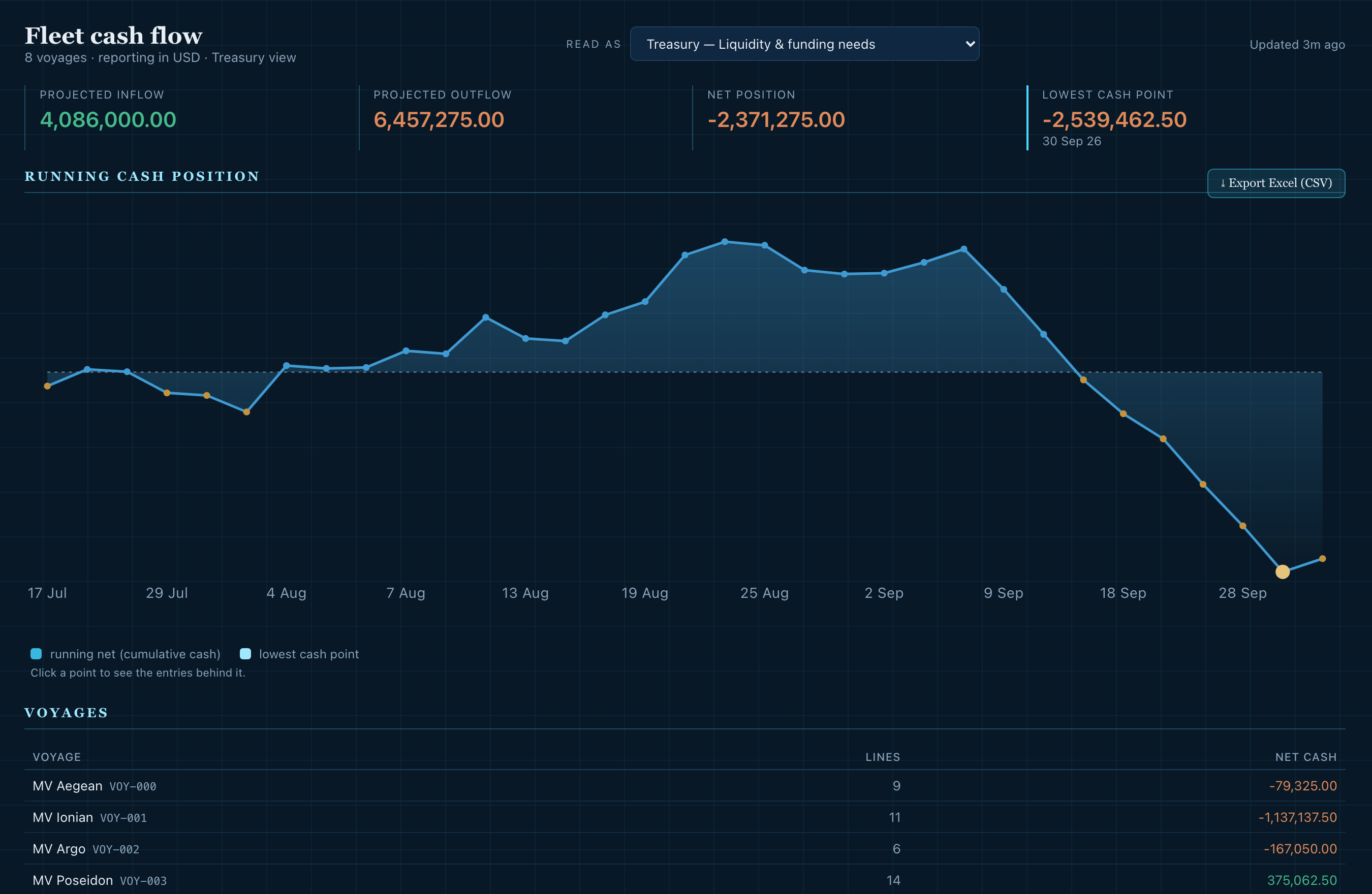
Vessels, counterparties and figures on a demonstration fleet. Nothing here is a customer’s.
What it holds
Four things the desk gets back.
01 · Cash forecast
What falls due, on which banking day, fleet-wide.
Costs and revenues projected onto real banking days, per voyage and across the fleet. Every line in its own currency, rolled to one company currency; confirmed reads solid, projected reads shaded, and the two are never mistaken for each other.
02 · Audit
Ask where any number came from. Get the document, the event, the rule version.
An event log records not just what is true but when it became true. So any number traces back to the event, document and rule version behind it, and you can replay the fleet as of any past date.
03 · Approvals
Three items, not forty.
Payables are derived from the forecast, so nothing due can be missing. Amount bands route each item to the right desk, four eyes means the raiser cannot approve, and an approval is a fact on the log, never an edited row.
04 · Desk views
Finance, Treasury, Ops and Commercial argue over the same forecast, not four different ones.
Four lenses over identical cash lines. Different lead figures, different emphasis, one forecast underneath.
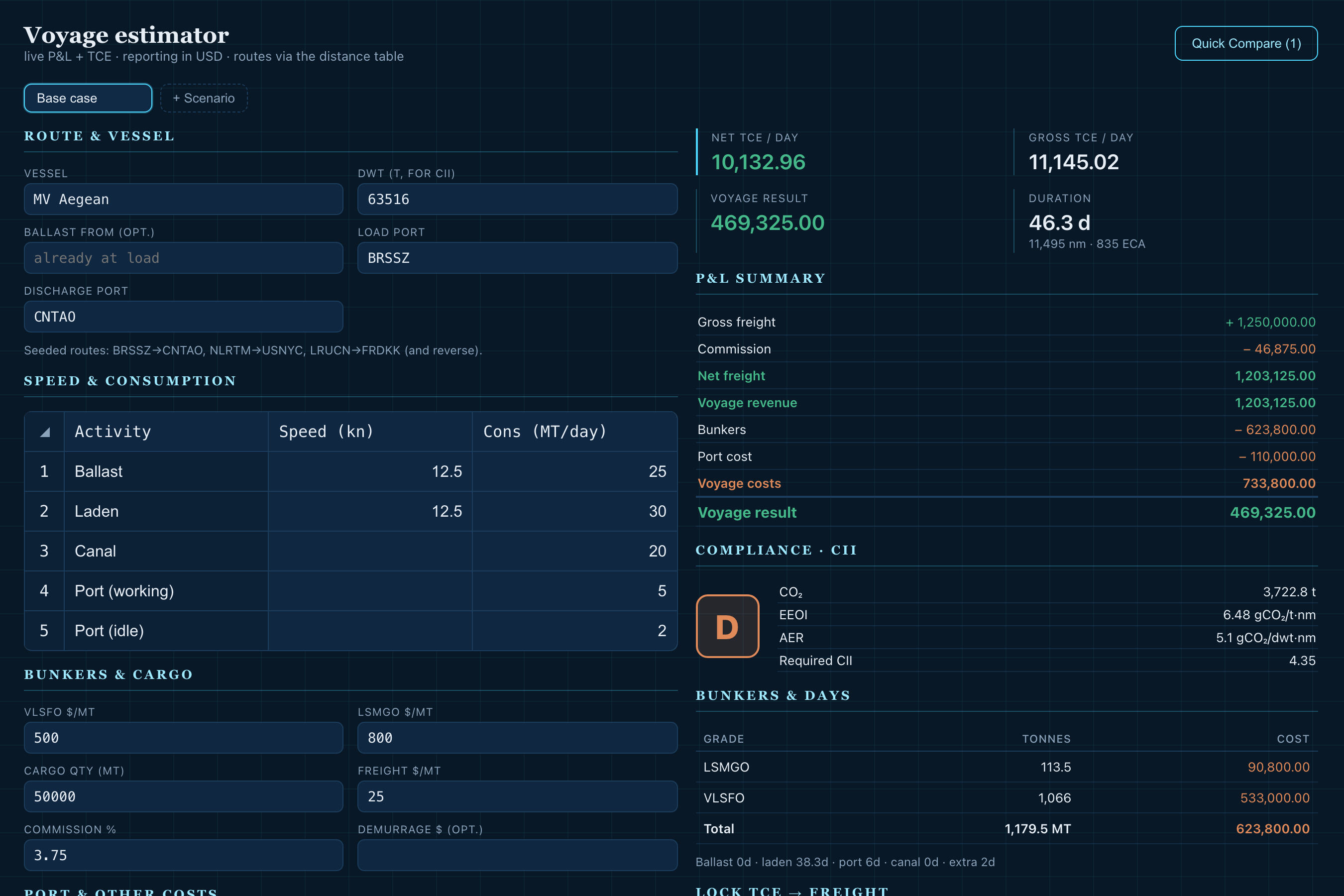
An estimate that wins the cargo becomes a real voyage in a single action. It schedules the itinerary from the commence date, maps it to the same events the live feeds produce, and ingests it. The voyage is event-sourced from the moment you fix it, and carries a cash forecast on day one.
Nothing is retyped, so nothing drifts. The numbers the desk committed to are the numbers the forecast starts from.
Bring a fixture you have already settled.
Thirty minutes. We build it in front of you, then show you the cash ladder it produces across sample voyages. If the numbers don’t hold, you have lost half an hour.