
VoyNex Estimator · Pre-fixture
TCE on three fixtures before the broker calls back.
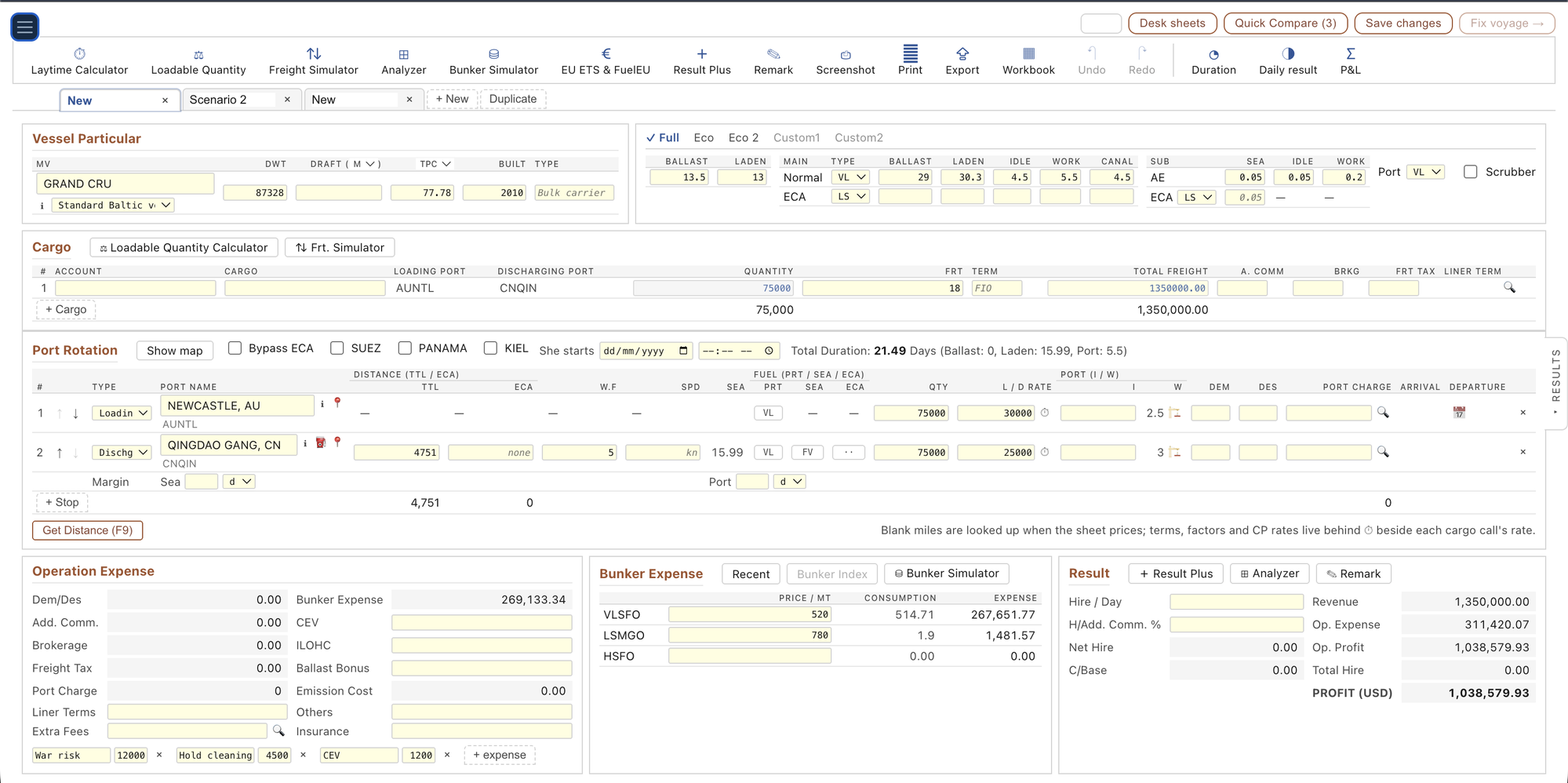
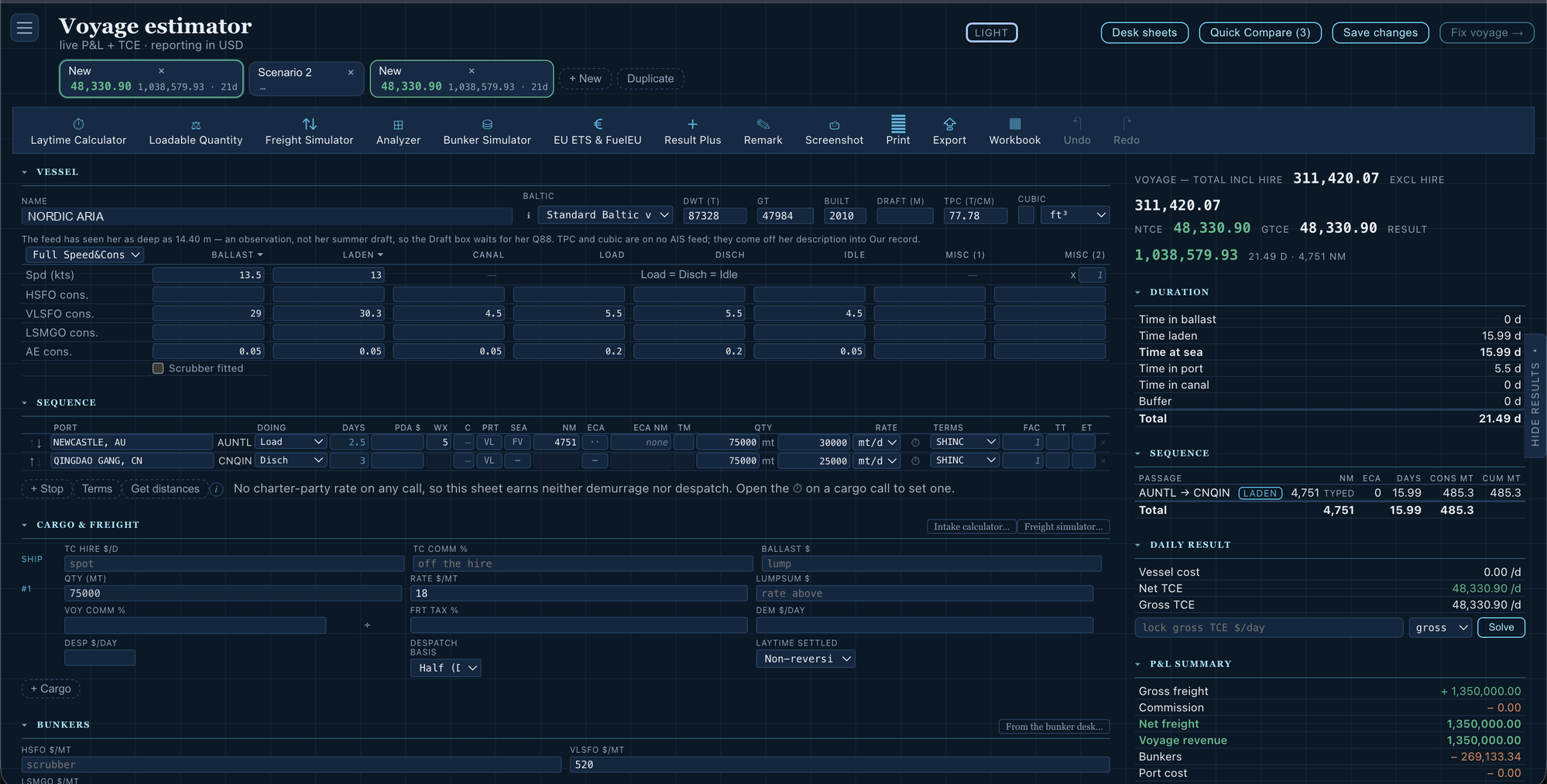
Put in the vessel, the rotation, the cargo and the prices. Get back the voyage P&L and the time charter equivalent, recalculating as you type, in the browser, at the density a chartering desk wants.
We built it inside a dry-bulk owner-operator's operation, against their live fixtures.
A chartering desk decides on TCE, the time charter equivalent in dollars per day. Give the estimator a vessel, a rotation, a cargo and a set of prices, and it builds the voyage P&L that TCE falls out of.
The engine is pure and deterministic: same inputs, same numbers, every time.
“A broker comparing three fixtures does not want a wizard.”The density is the tool, not a thing to be fixed.
What it holds
Four things a desk asks of a sheet.
01 · The sheet
No wizard. One sheet, every figure live.
Vessel particulars, five saved speed profiles switchable leg by leg with port burn included, multi-fuel consumption grids per zone, and a rotation with per-leg speed and ECA.
02 · Solvers
Ask “what freight hits $32,000/day?” Get the exact answer, not a guess.
Freight for a target daily, hire for a target profit, break-even ladders. Profit is linear in freight and hire, so these solve exactly rather than converging on an answer.
03 · Emissions
EU ETS and FuelEU priced per leg, so the Baltic leg doesn't pay for the Med.
EU ETS tank-to-wake with the phase-in, FuelEU well-to-wake against the declining baseline, and the EU boundary applied leg by leg rather than to the voyage as a whole.
04 · Laytime
Demurrage settled before you fix, not disputed after.
Laytime on SHINC, SHEX, SSHEX or FHEX terms, counted day by day with holidays, and demurrage or despatch settled at the end. Loadable quantity against DWT, hold volume and draft at each end.
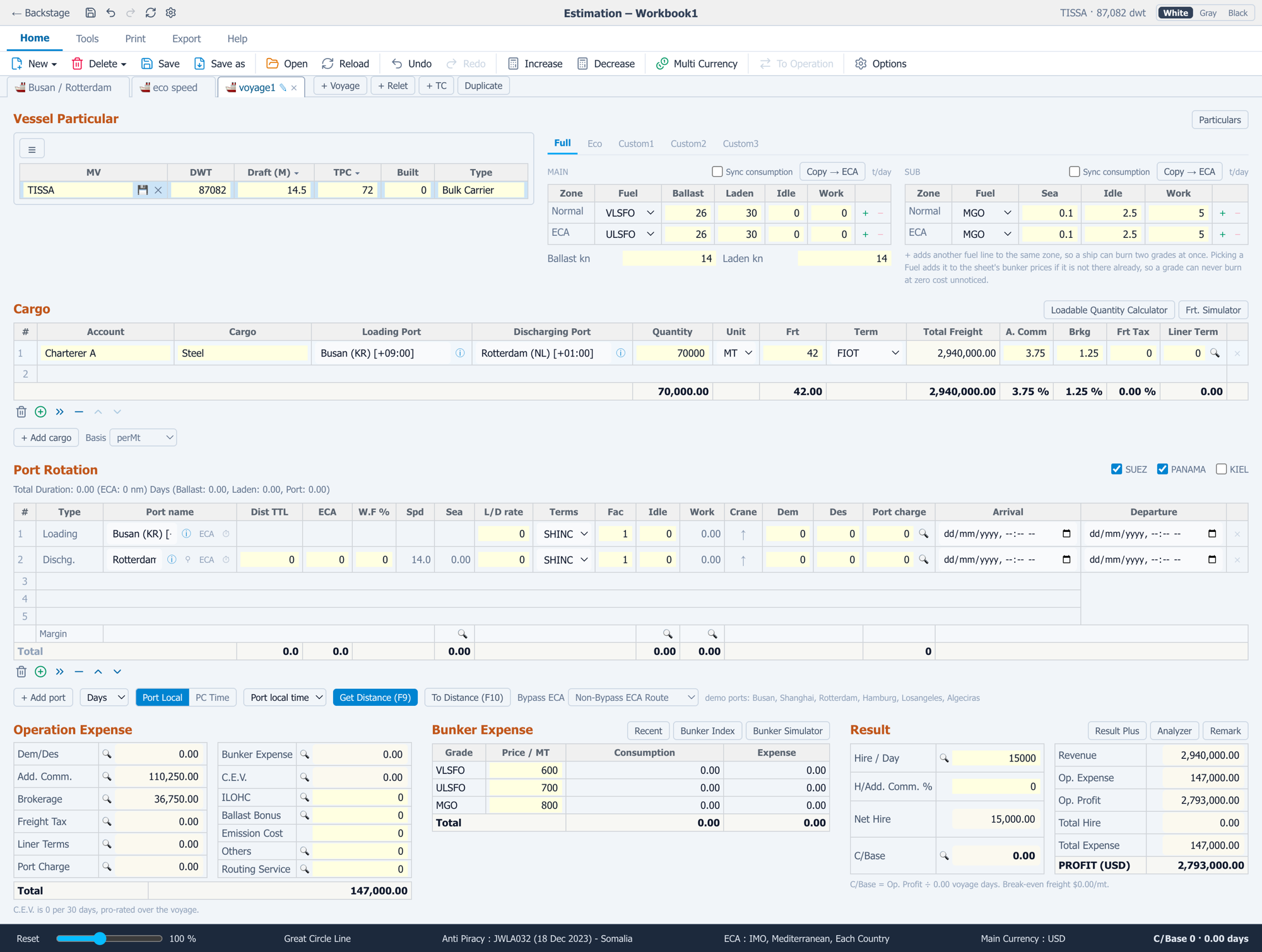
Build the same voyage here and in the licensed Windows tool your desk uses today, and the two agree on duration, bunkers, port charges, earnings per day and profit. We run that check on every code change.
Switching costs almost nothing. Point it at the report your current tool exports and the estimate rebuilds itself.
- Bunker planning. Opening stems, where she stems, whether it lasts, and two speed profiles side by side
- Shared vessel lists by link, so the desk works off one library rather than five
- Every sheet stamped with who changed it and when
- PDF and Excel export with signature blocks
Three things it does not have. There is no vessel database, so your desk builds its own library. It runs on one server today, so we make no enterprise-scale claims. It speaks English only.
Check it against a voyage you already settled.
Bring the vessel, the rotation, the cargo and the prices you fixed at. We build it in front of you and you compare our TCE against what you actually closed at. No deck, no demo script.