
Software for shipowners and operators. Nothing else.
Know what your fleetpays out next Tuesday.Before Tuesday.
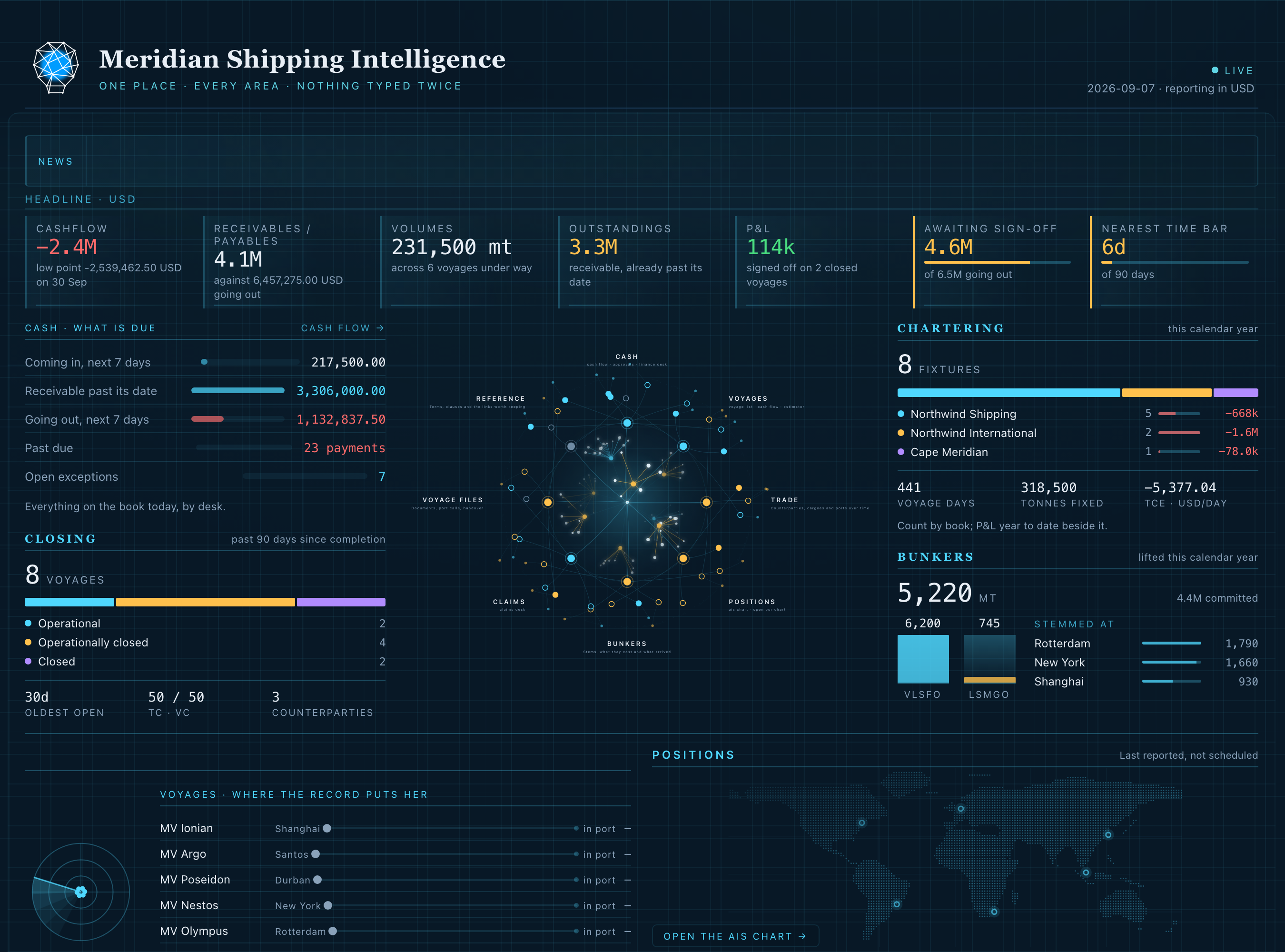
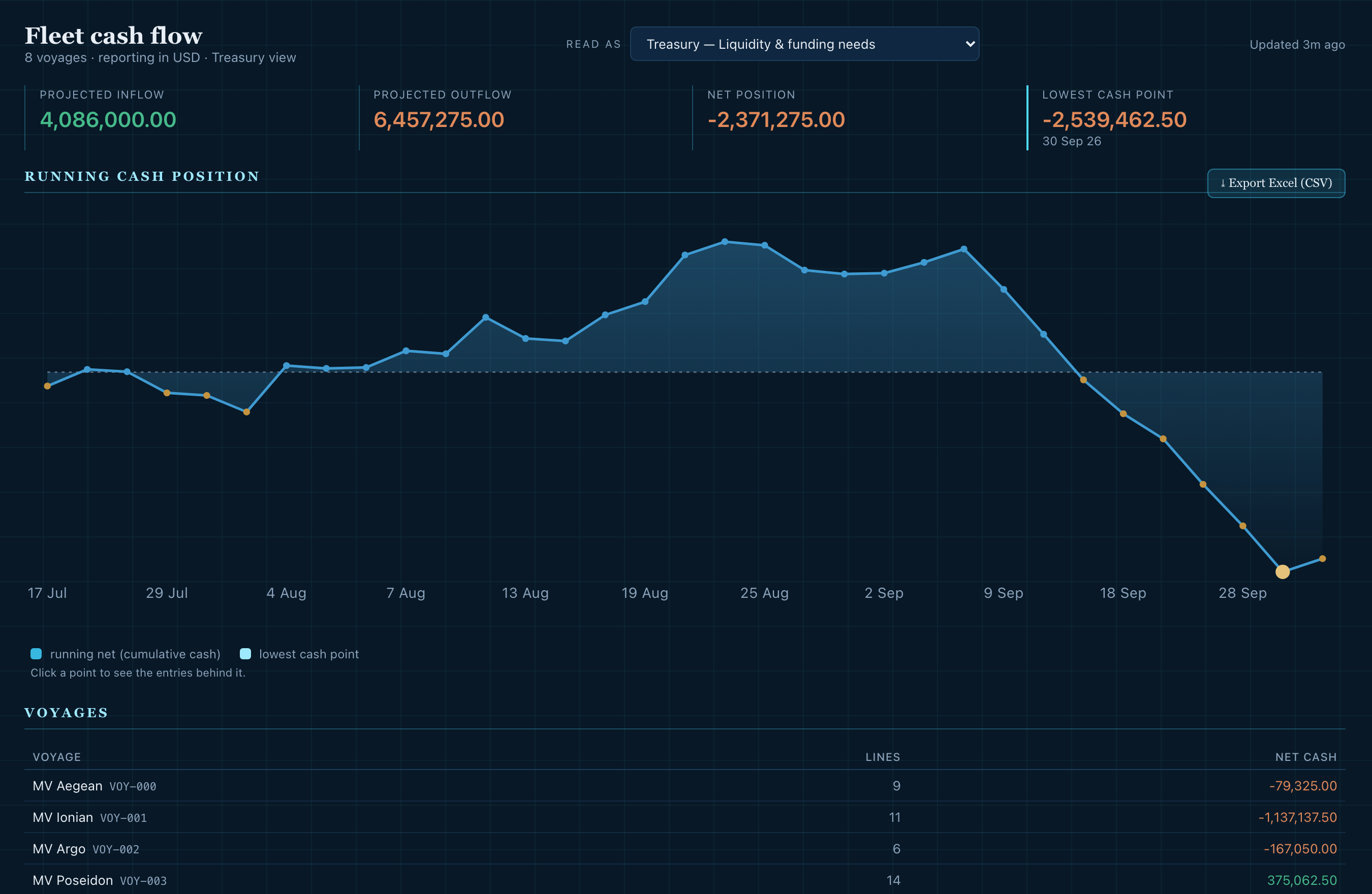
Two products, one either side of the fixture. The first tells you whether the voyage is worth taking. The second runs it and shows you the cash it actually moves, by banking day, across the fleet, with every figure traceable to the document behind it.
We built it inside a dry-bulk owner-operator's operation, against their live fixtures.
01 The chartering desk
Paying per seat for a tool that lives on one laptop.
01
Per seat, per year, and you still can't share an estimate.
The tool you have is licensed per machine. The desk has moved to laptops; the licence hasn’t.
02
Every estimate on one person's machine.
When they go on leave, so does the history. Nothing to hand over, nothing to compare against.
03
Windows only, and metered.
You think twice before trying an alternative route because each query costs. That’s a tool shaping the decision instead of serving it.
02 Finance and treasury
Running the fleet on a spreadsheet nobody fully trusts.
01
The estimate and the voyage never match.
The fixture is won on one sheet and run on another. Every re-keyed figure is a place the two can drift, and they do.
02
Your VMS tells you what happened. Not what falls due.
Post-fixture systems are records. None of them puts next month’s payables on real banking days, per voyage, fleet-wide.
03
Forty approvals, three of which matter.
When payables aren’t derived from a forecast, finance signs off on a queue nobody can reconcile back to a cause.
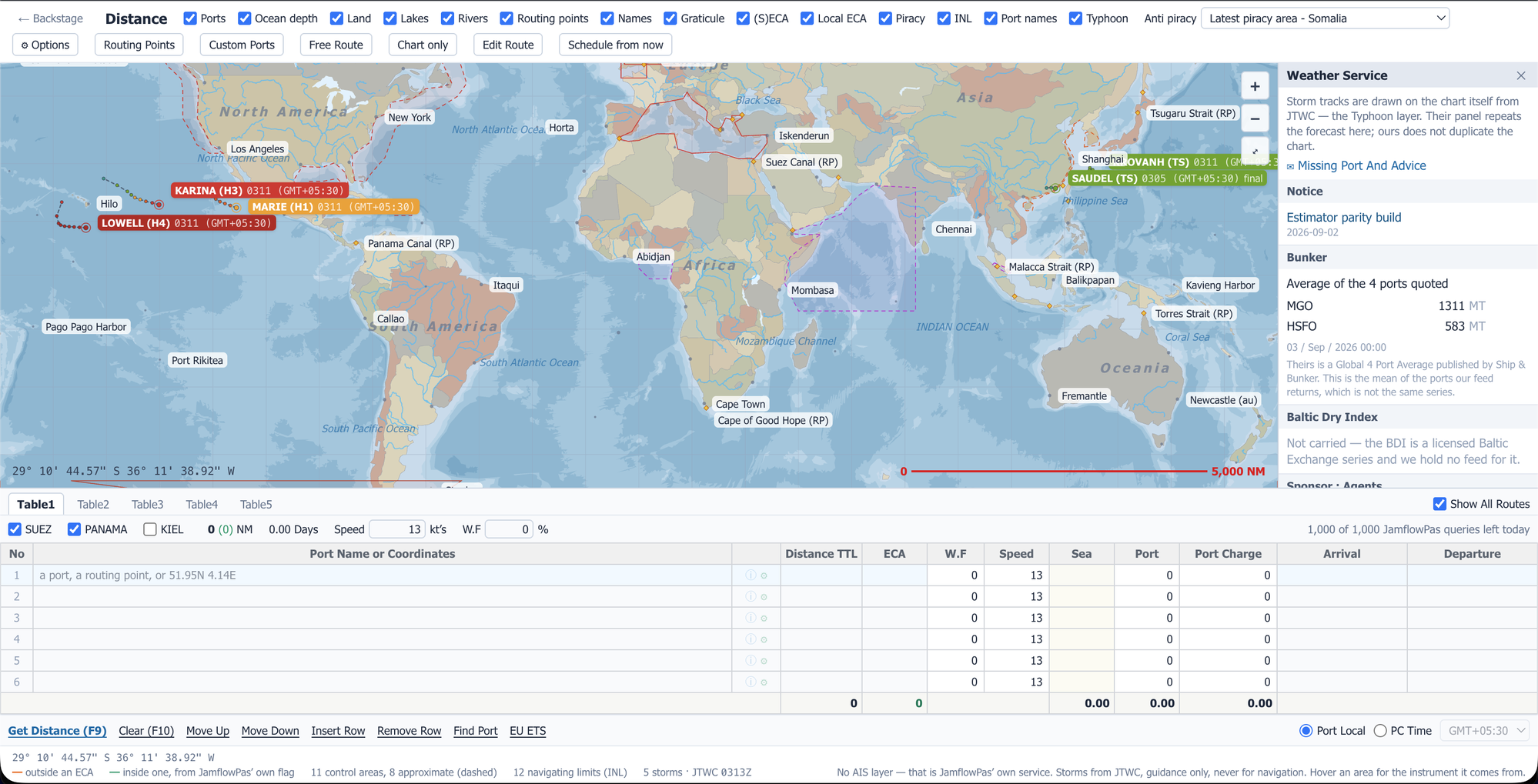
EU ETS hits 100% in 2026 and FuelEU already applies. You price both leg by leg, and only for the legs inside the EU, working in the year-by-year phase-in and any ice-class relief. Guess either one and you can lose the fixture on it.
Estimator prices both inside the voyage rather than bolting them on afterwards, and Distance shows you the ECA miles on the chart before you commit.
The desk that gets this right in 2026 wins fixtures the desk that guesses will lose by five cents.
04 The desk's whole day, in one system
From an email to a priced voyage, without retyping anything.
This is the story a competitor made of separate tools cannot tell.
| Step | Product | The desk does |
|---|---|---|
| 01 | Mail Analyser (next) | A cargo offer lands in the inbox and becomes a row on the cargo list. Nobody types it. |
| 02 | Estimator | Pick the ship. The rotation builds itself from the load and discharge ports. |
| 03 | Distance | One click sends the rotation to the chart. Measure it, route around a canal or a war-risk area, then send the miles back with the ECA miles counted separately. |
| 04 | Estimator | Bunkers, ports, canals, commissions and emissions price themselves. Earnings per day. |
| 05 | Voyage Manager | The fixture you win becomes the voyage. The cash it moves appears on the ladder, by banking day. |
Build the same voyage in Estimator and in the licensed Windows tool your desk uses today, and both come out the same. Duration, bunkers, port charges, earnings per day, profit. We run that check on every code change.
It is the only proof that needs no customer, and it is the one a chartering desk cares about. Arithmetic is not a matter of opinion.
A chartering desk gets hundreds of cargo offers and position lists a day, all of it free text. Someone reads them and retypes the useful ones.
Mail Analyser will connect to your own mail account, pull the stem, quantity, ports, laycan and rate idea out of each offer, and hand it to Estimator as a started estimate. It attaches the original email, so you never have to take its reading on trust.
It reads your existing voyage system on a schedule and builds the record from that, so you never face a cutover and nobody retypes a voyage. Run both on the same voyages until the numbers agree, then move the desks over in whatever order suits you.
Runs in the browser, nothing to install, 2–8 weeks to first live voyage.
Bring a fixture you have already settled.
We build it in front of you in thirty minutes. Vessel, rotation, cargo, prices. Then you check the result against what you actually closed at. If the numbers don’t hold, you have lost half an hour.